
Web development company Dubai How to deliver a bilingual site that converts on mobile and ranks
By Esar-ul-Haq Qasmi ·
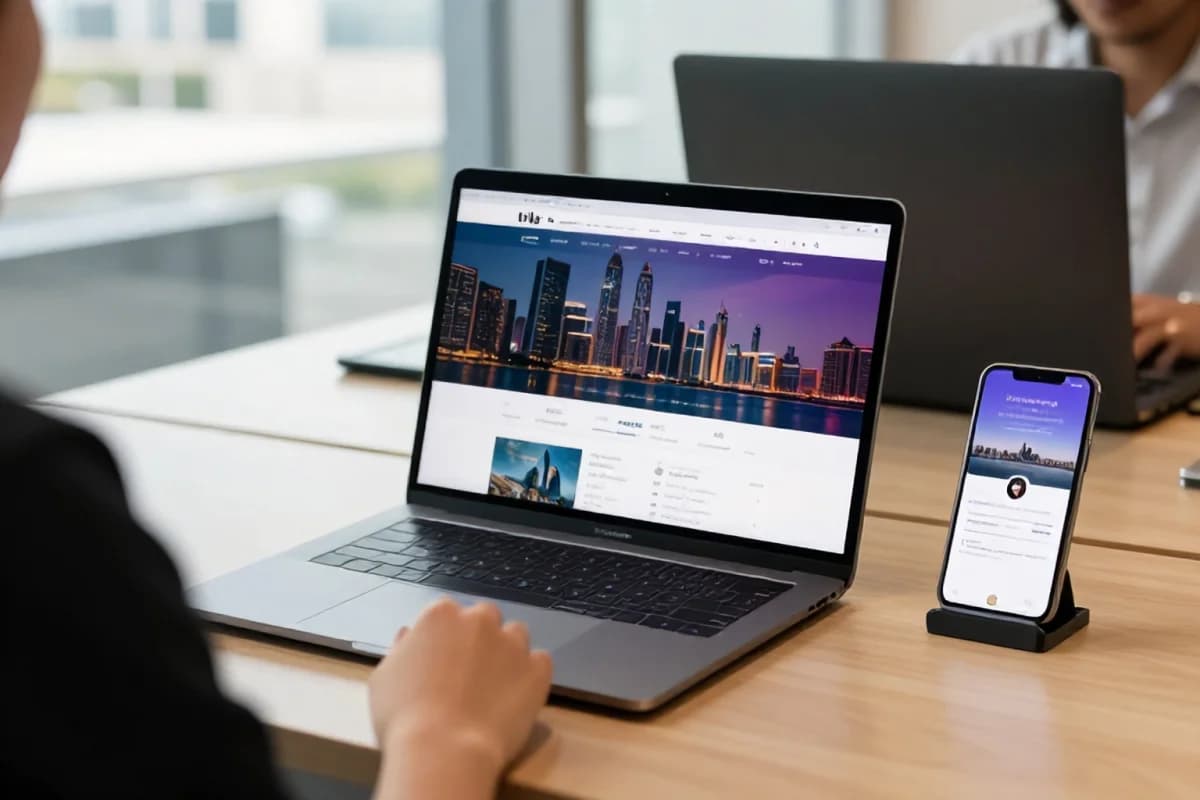
If you are hiring a web development company Dubai or planning an in-house build, start with a bilingual conversion and tracking plan, then map pages and content before you write code. In Dubai, your site should work perfectly on mobile, load fast on real networks, and integrate with WhatsApp and Google Maps so prospects can act immediately.
Use this checklist to brief your developers, avoid common launch failures, and build a site that supports both conversions and local SEO signals from day one.
Target search phrase and what “web development company Dubai” really means for your build
When UAE businesses search for a web development company Dubai, they usually need more than design and coding. They need a build that connects:
- Bilingual experience (Arabic and English) without duplicate content confusion.
- Mobile-first performance for commuters, busy decision-makers, and on-the-go searches.
- Local intent signals (location, services, maps, and clear calls to contact).
- Conversion paths (lead forms, calls, email, and WhatsApp) with measurable tracking.
- Operational ease for marketing teams to update pages during seasonal pushes like event season, Ramadan, back-to-school, and DSF without breaking the site.
Key takeaways
- Build the bilingual sitemap and content ownership model before design and development.
- Use a clear conversion architecture: WhatsApp and phone above the fold, forms that qualify, and thank-you pages tracked end to end.
- Get performance and tracking right before you launch: Core Web Vitals, analytics events, and error monitoring.
- For Dubai, strengthen local intent with location-specific pages, consistent NAP, and embedded maps where relevant.
- Plan a pre-launch QA checklist for Arabic layout, RTL edge cases, and mobile performance on real devices.
1 Create your bilingual conversion plan before the build
Many bilingual websites fail because they are treated as “translation only”. For Dubai audiences, you need conversion logic in both languages: the visitor should understand what to do next instantly.
Define one primary conversion per page
Pick one primary action per page. Examples:
- Service page: “Request a quote” or “Talk on WhatsApp”.
- Landing page for an event or campaign: “Register” or “Book a consultation”.
- Industry page: “Call now” and “Send enquiry” with fast form completion.
Decide your Arabic and English content ownership
Before development starts, confirm who creates and approves Arabic content. If you translate late, developers end up rebuilding layouts, and QA slows down.
For Arabic, plan for:
- RTL layout behavior across navigation, forms, and modals.
- Font and line-height so Arabic text doesn’t break buttons or headings.
- Form field ordering and validation messages that feel natural to Arabic users.
2 Build a Dubai-ready information architecture that supports local intent
A site that ranks locally and converts behaves like a fast answer engine: users find the exact service and the nearest way to contact you without scrolling endlessly.
Use a practical bilingual page structure
Common approaches include separate language URLs or equivalent localized URLs. Whatever structure you use, keep it consistent:
- Same page purpose in Arabic and English.
- Same primary conversion goal.
- Equivalent internal linking so navigation and search behavior match between languages.
Create location and service coverage pages where it helps sales
For Dubai audiences, location clarity matters. Examples of pages that typically work well:
- “Services in Dubai” hub page that links to each service page.
- Service-specific landing pages that mention Dubai delivery context (without stuffing).
- Contact page that includes office area guidance, map embed, and “fast contact” options.
Tip for briefs: ask your web development company Dubai to list how each page supports a stage of the buyer journey (awareness, consideration, decision) and how it routes visitors to contact.
3 Conversion architecture for Dubai: mobile, speed, and WhatsApp-first paths
In Dubai, many prospects start on mobile and want immediate action. Your site should make “contact now” easier than “browse more”.
Above-the-fold contact should be bilingual and clickable
- Phone number button (tap-to-call).
- WhatsApp button that opens the correct conversation with a pre-filled message.
- Email link and a short form option that doesn’t require too much typing.
If you run marketing campaigns, ensure the conversion path is consistent across campaign landing pages and the main site navigation.
Forms that qualify instead of collecting everything
For decision-makers, a short form can outperform a long one. A practical approach is to collect:
-
- Name and work email or phone.
<liCompany name.
<liService of interest (dropdown).
<liBudget range and timeline as optional qualifiers (only if your sales process benefits).
Make sure every form submission lands on a bilingual thank-you page, and track it as an event.
4 Tracking and reporting that matter for web development decisions
A web build should never be “fire and forget”. Your marketing manager needs tracking events that answer real questions like: Which pages produce leads? Which language version converts better? Where do mobile users drop off?
Set up these measurement points before launch
- Page views by language.
- CTA clicks: WhatsApp button, call button, form submit.
- Form funnel: start, validation errors, submit success.
- Thank-you page views as confirmation of conversion.
- Outbound clicks (if you link to calendars, registration, or other systems).
Instrument UX friction, not only outcomes
Also track:
- 404 errors and broken internal links.
- Slow-loading page events (so you can prioritize fixes).
- Mobile scroll depth for key landing pages (useful for content-led pages).
5 Performance targets and QA for real mobile networks in Dubai
Fast pages improve user experience and reduce drop-off. For Dubai, your QA should reflect how users actually browse on mobile networks.
Plan a performance QA checklist
- Test Arabic and English layouts on small screens.
- Check hero image sizes and video loading behavior.
- Confirm that fonts load smoothly without layout shifts.
- Verify lazy loading strategy for images and below-the-fold media.
- Test core journeys: browse service pages, click WhatsApp, submit the form.
Use the right tools and baselines
Ask your development partner to share a simple before-and-after performance report. In your brief, request measurements aligned with Core Web Vitals. For the metrics themselves, refer to Google’s documentation: https://web.dev/vitals/.
Example (numbers you can use in QA): In practice, Core Web Vitals reporting uses thresholds for LCP, INP, and CLS. You can use Google’s published guidance as your acceptance basis. Source: https://web.dev/vitals/.
6 SEO foundations embedded in the build without overcomplicating it
SEO for a bilingual Dubai website is a build-and-content workflow problem, not a one-off technical ticket.
Implement technical essentials consistently across languages
- Clean internal linking between Arabic and English relevant pages.
- Correct handling of language versions.
- Structured data where appropriate for your content types (only where it fits).
- Accessible navigation and readable headings for both languages.
Avoid duplicate-content traps during translation
Don’t copy English content into Arabic pages without review. If the page exists in both languages, make sure the Arabic version matches the page purpose and includes location context where relevant.
If your team is short on Arabic production capacity, prioritize the highest-intent pages first: homepage, service pages, contact, and top landing pages for campaigns.
7 A practical launch plan for November: protect campaigns and keep updates safe
Early November is a useful checkpoint because teams are preparing for the event season momentum and end-of-year activity. Use this to avoid last-minute changes that break pages or tracking.
Launch in stages to reduce risk
- Stage 1: Publish the new structure for key pages (homepage, top services, contact) in both languages.
- Stage 2: Migrate the remaining service and content pages.
- Stage 3: Activate campaign landing pages and integrate registration/consultation flows.
Freeze changes during final QA
In the last 3 to 5 business days before go-live, stop adding new pages or changing layouts. Focus on:
- Tracking verification (form submits, thank-you pages, WhatsApp button clicks).
- Arabic RTL checks on navigation and forms.
- Mobile performance tests.
- Broken link scan and redirect validation.
8 How to brief a web development company Dubai so you get the outcomes you need
Use this briefing template in your discovery call. It’s designed for marketing managers and founders who want clear decisions, not vague deliverables.
Ask these questions
- Bilingual implementation: How do you handle Arabic RTL layouts across templates, forms, and CMS fields?
- Performance: What acceptance targets do you use for LCP, INP, and CLS?
- Tracking: What events will you implement for WhatsApp clicks and form submissions, and how do you validate them?
- Content workflow: How will our team add and update bilingual service content without breaking layout?
- Local intent: How do you plan pages to support Dubai search behavior and contact conversion?
- Post-launch support: What monitoring do you provide for broken links, errors, and performance regressions?
DXB360 fit: one team to connect design, development, and measurement
If you want the site to behave like part of a broader campaign system, DXB360 can align the web build with your digital marketing and experiential plans. That means fewer handoffs, cleaner tracking, and web content that matches your offline and online touchpoints.
Start with the right service page:
- Web Development: /services/
- Our Services overview: /our-services-3/
- Process (how DXB360 runs delivery): /our-process/
For campaign-ready conversion flows, you may also want registration and consultation patterns:
Related DXB360 blog posts to connect the dots
These articles complement the web build checklist by focusing on SEO, measurement, and bilingual execution:
FAQ
How long does a bilingual website build take in Dubai?
Timeline depends on scope and how quickly Arabic content is finalized. Ask the developer for a stage-based plan (key pages first, then migration) and include time for RTL QA, tracking validation, and performance testing.
Should the Arabic version be a full translation or localized copy?
For Dubai conversion, localize. Arabic pages should match intent, include relevant Dubai context where it supports understanding, and use the same primary conversion goal as the English page.
What tracking should we insist on from day one?
At minimum: CTA clicks (WhatsApp, phone), form start and submit events, and thank-you page views by language. Validate tracking before the site goes live.
Does our website need both SEO and digital marketing work?
SEO foundations are built into the site, but performance improves when your marketing team aligns page content with targeting. Treat the website as the conversion and measurement layer for your broader campaign strategy.
What should we test specifically for Arabic users?
RTL layout behavior, navigation usability, form field ordering and validation messages, and mobile rendering for Arabic headings and button labels.
If you want a bilingual, Dubai-ready website plan built around measurable conversions, reach out to DXB360 and we can discuss your current pages, goals, and next steps.